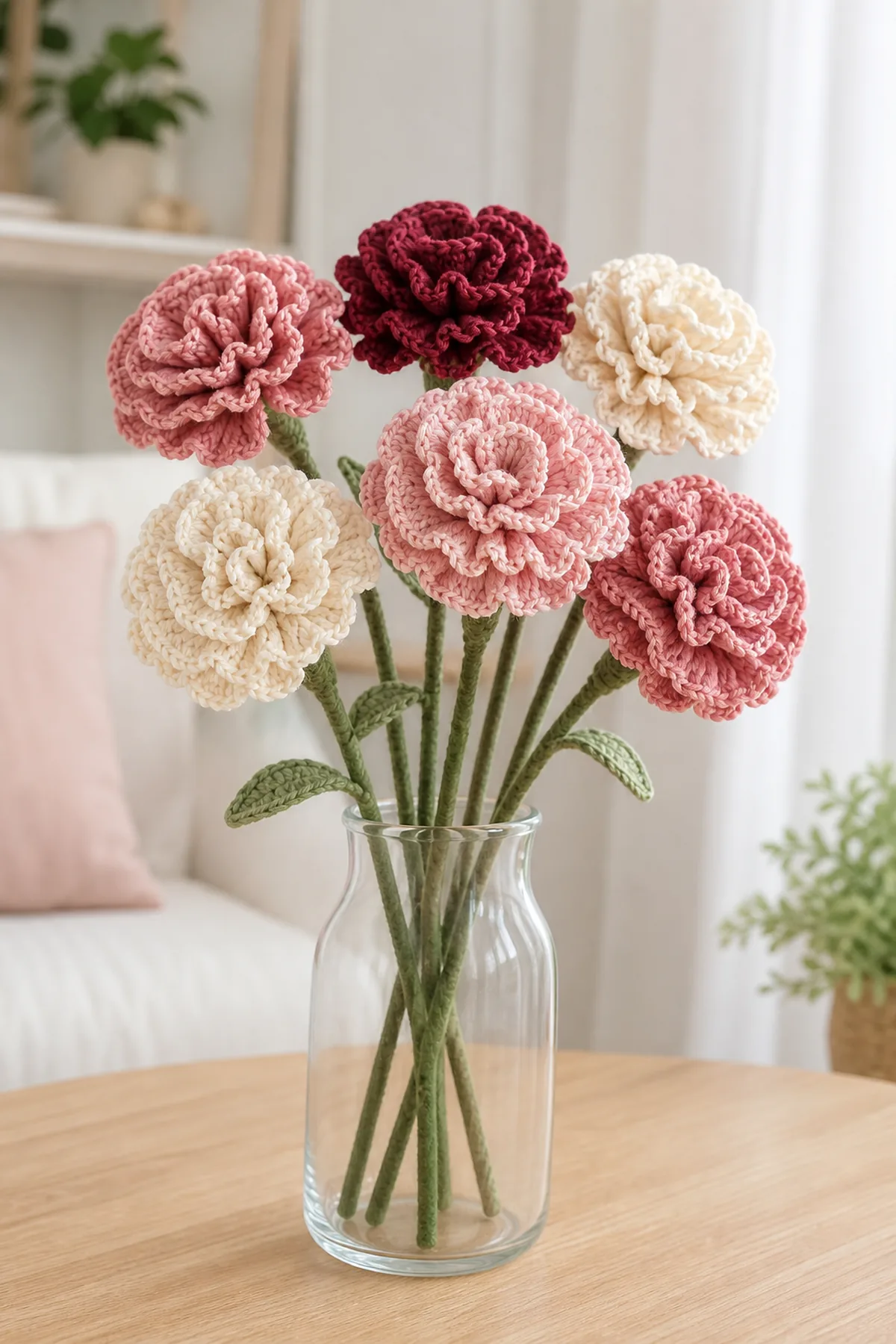
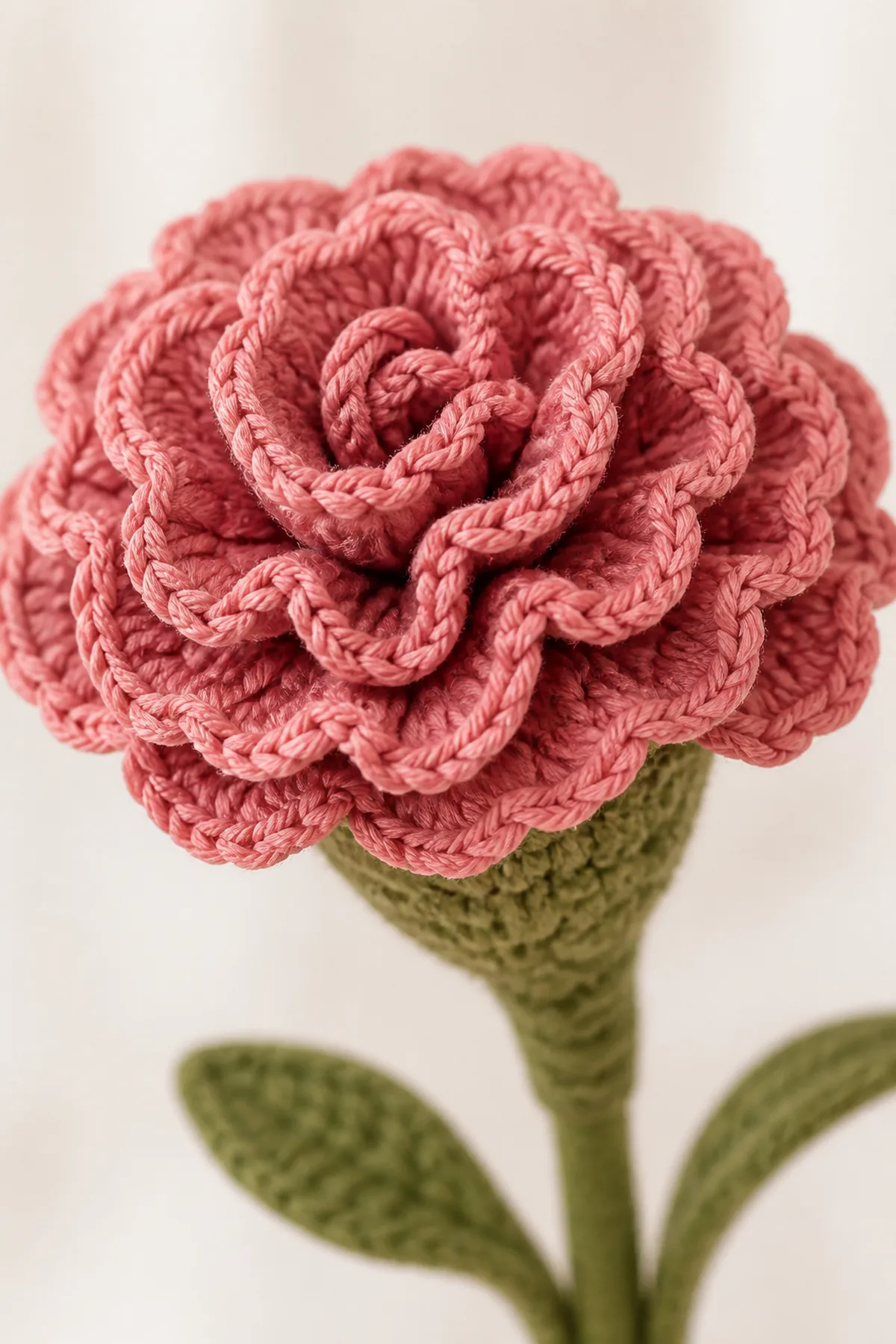
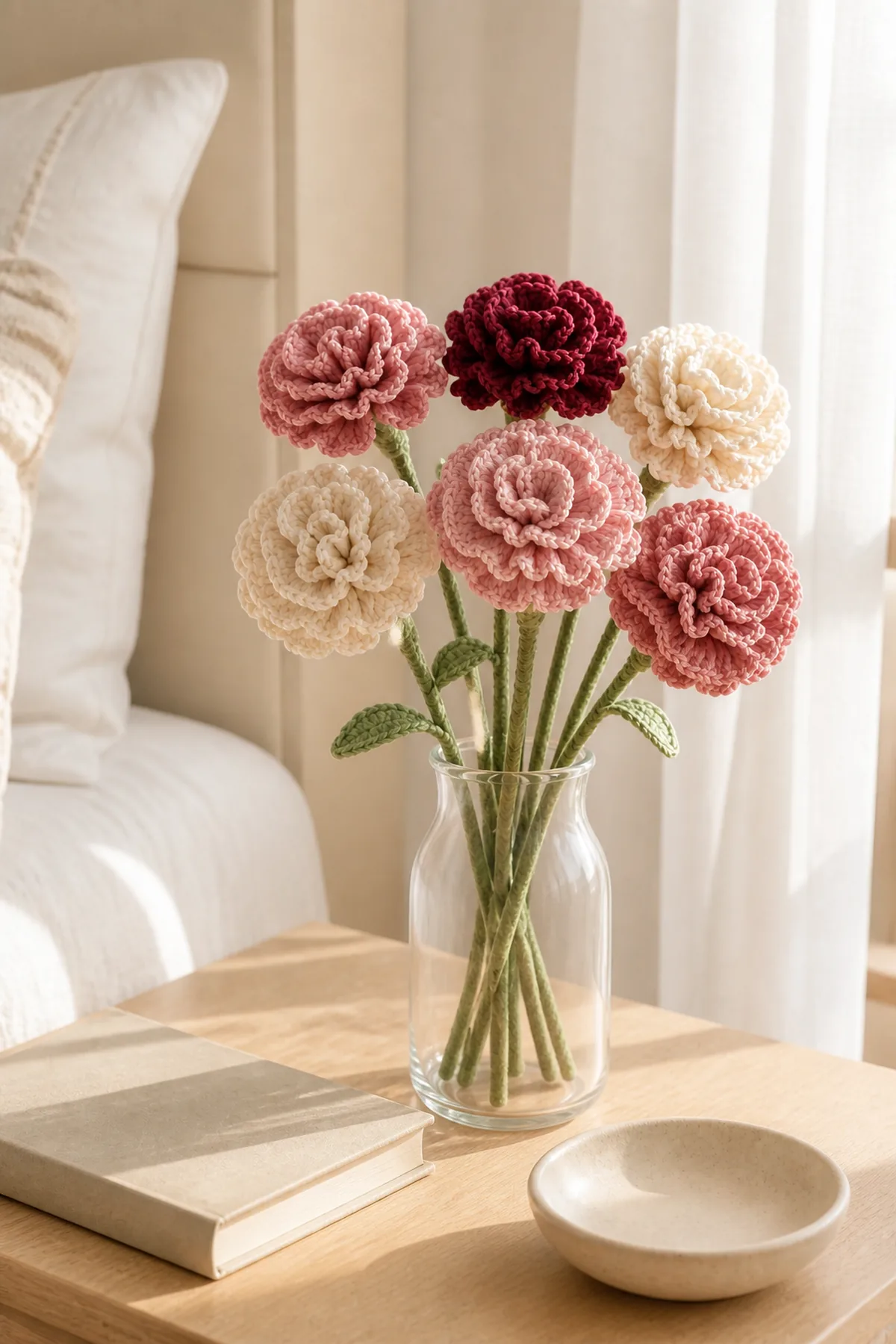
This crochet carnation flower in a vase pattern makes a full ruffled bloom from one precisely counted strip. Three derivable rows produce the petal volume, while a closed-loop floral wire, secure base stitches, green wrap, and optional leaf create an executable decorative stem.
Pattern Details
- Hook Size: 3.5 mm (E-4)
- Finished Size: Each bloom is approximately 3.5 inches across on a 12-inch covered stem
- Gauge: 15 single crochet stitches = approximately 4 inches along Row 1
- Terminology: US
- Estimated Time: 1.5–2 hours per flower
- Construction: A 60-stitch strip expands to 180 and then 360 stitches, creating ruffles that are rolled, sewn through the straight base, and secured to a safely looped floral-wire stem.
- Skill level: Easy
Why You’ll Love It
The increase logic is simple to audit: 60 stitches become 180, then 360. Repeat the flower in dusty rose, blush, cream, and muted burgundy for a bouquet that never wilts.
Materials
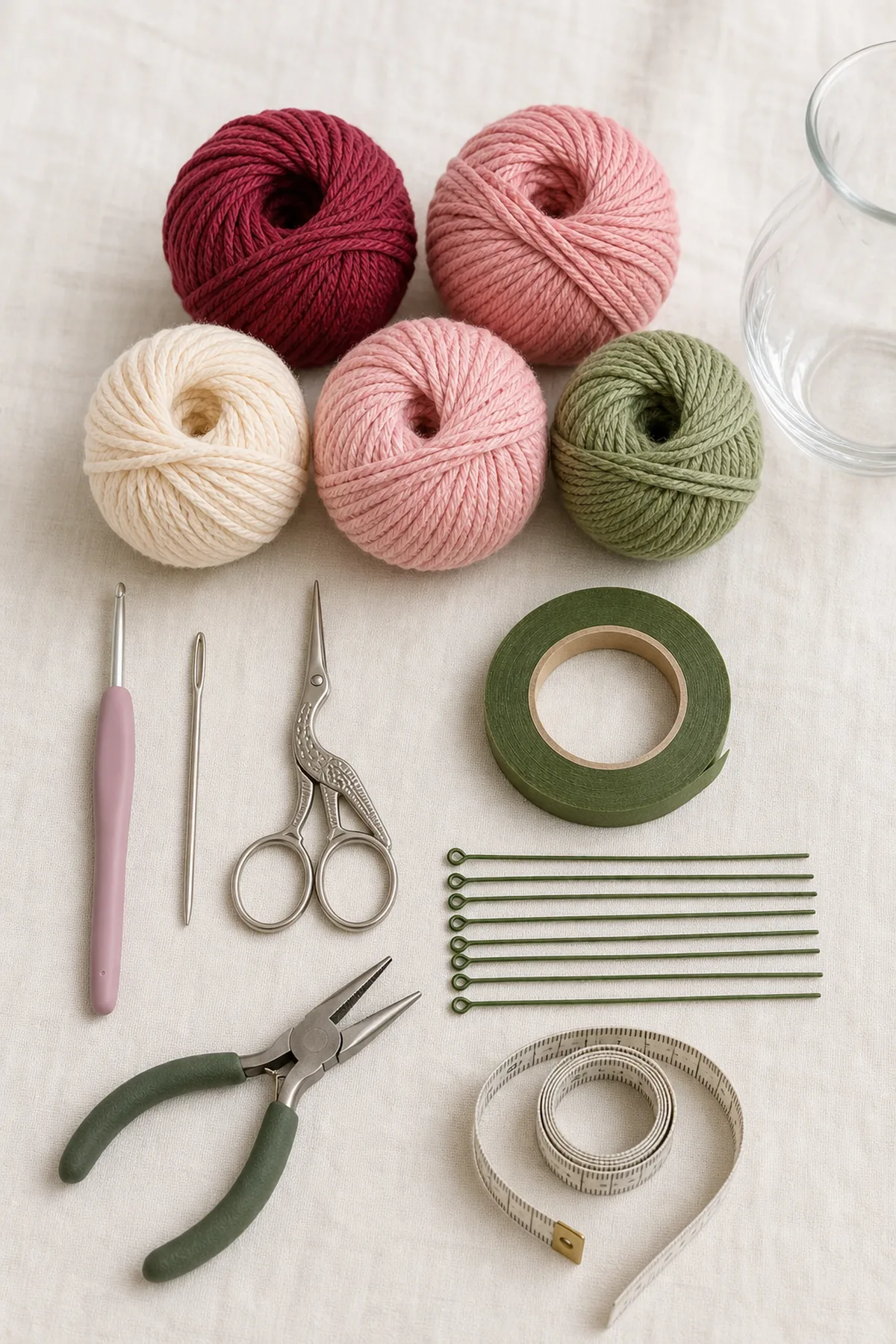
- Approximately 45 yards worsted-weight cotton yarn per bloom
- Approximately 20 yards sage worsted cotton per stem and leaf
- 12-inch 18-gauge floral wire with top end curled into a closed loop
- Green floral tape
- 3.5 mm crochet hook
- Needle-nose pliers and wire cutters
- Yarn needle
- Scissors
- Simple glass vase for display
Abbreviations
- ch: chain
- dc: double crochet
- hdc: half double crochet
- sc: single crochet
- sl st: slip stitch
- st(s): stitch(es)
Important Notes
- Use pliers to form a closed wire loop before the wire approaches the crochet fabric.
- These decorative flowers are not toys and should stay away from small children and pets.
- The turning chain never counts as a stitch.
- Work every increase into the next actual stitch; do not skip positions.
- The vase is a separate household container and is not crocheted.
Complete Carnation Instructions
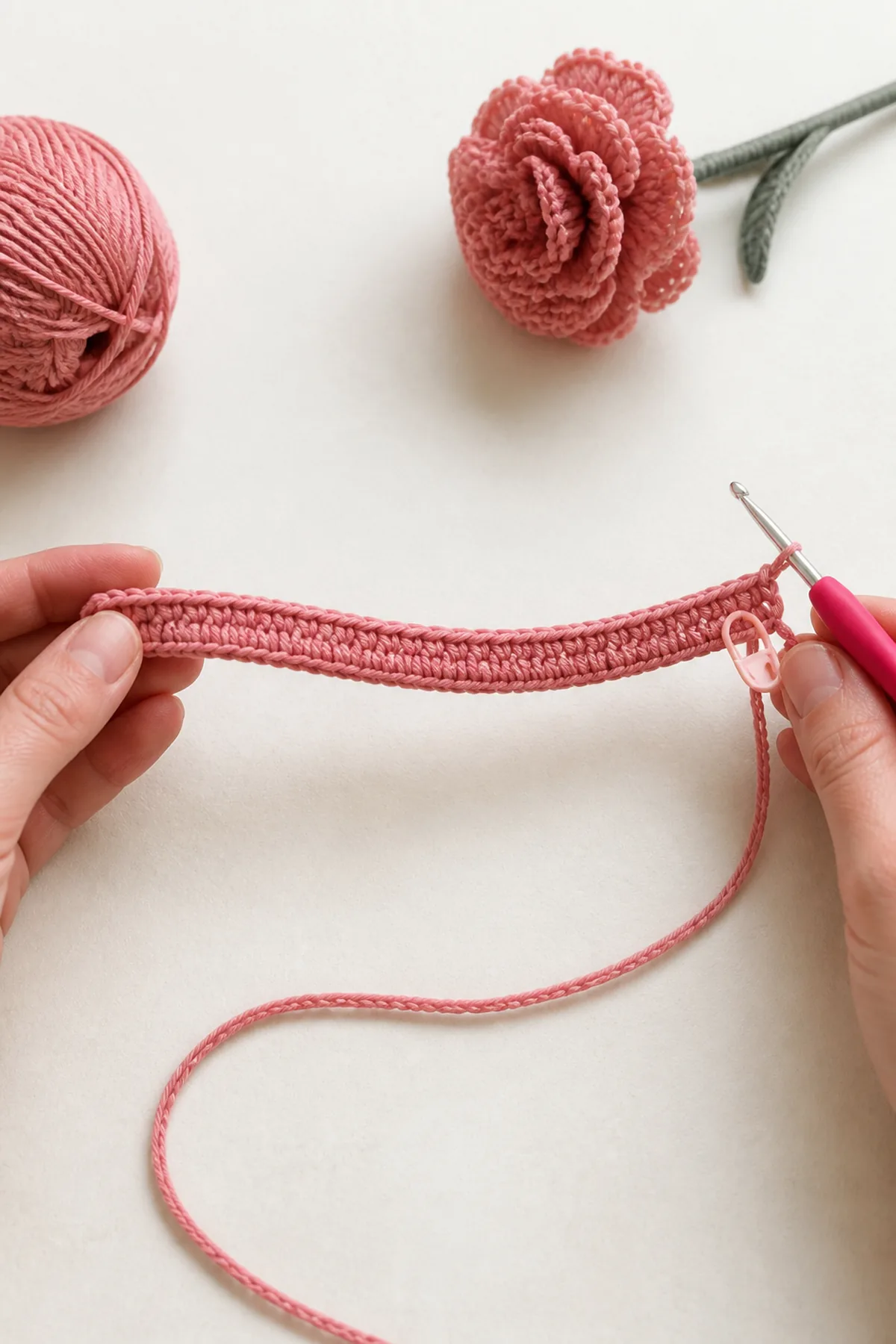
- Foundation/Row 1: Ch 61. Turn, skip the first chain, and work 1 sc in each of the next 60 chains. Ch 3 and turn; the turning chain does not count. (60 sts)
- Row 2: Work 3 dc in each of the 60 stitches across. Ch 2 and turn; the chain does not count. (180 sts)
- Row 3: Work 2 hdc in each of the 180 stitches across. The strip will ruffle strongly. Fasten off with a 36-inch sewing tail. (360 sts)
Roll and Secure the Bloom
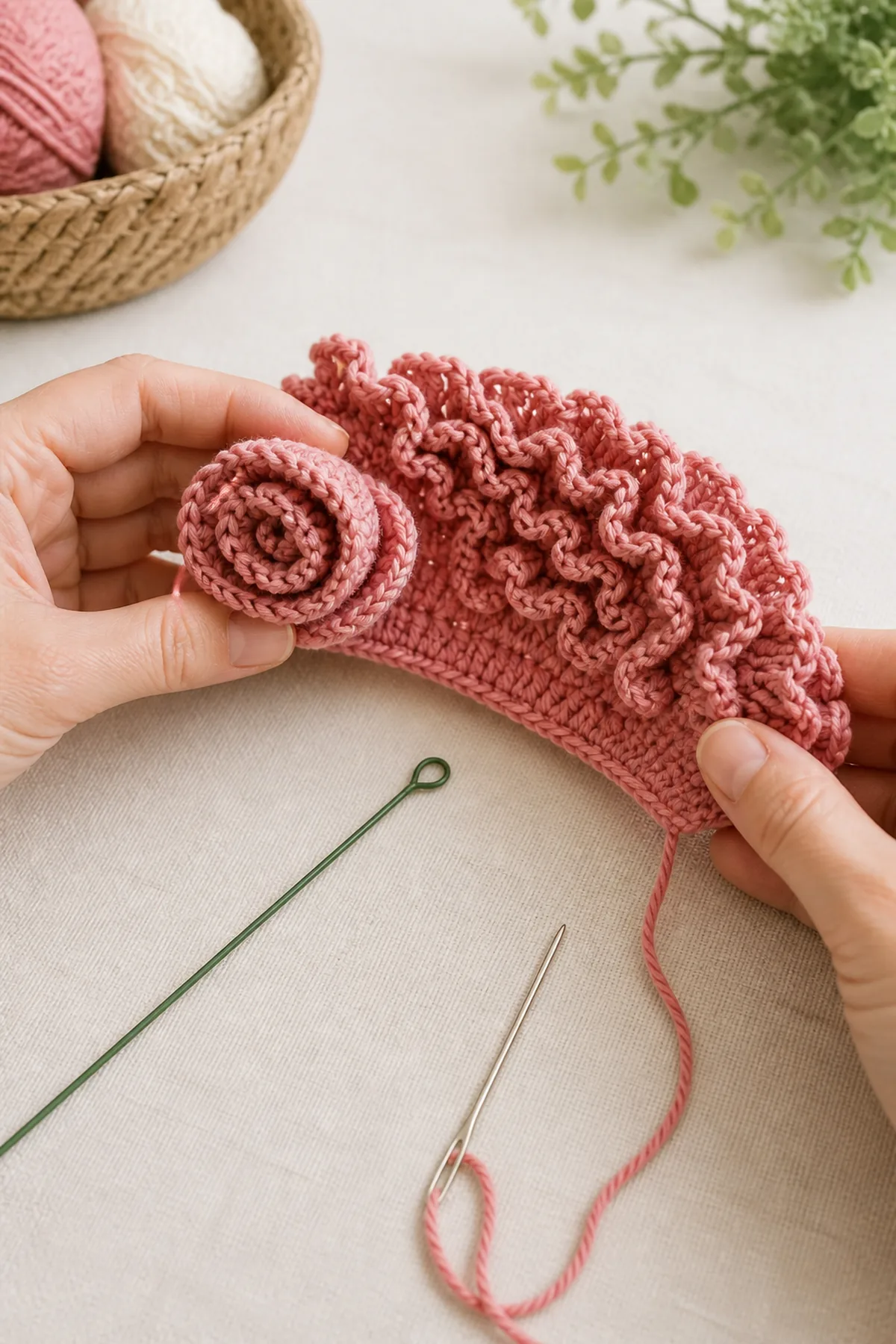
- Place the strip with the straight Row 1 edge toward you. Beginning at one short end, roll the base tightly for the first inch, then continue rolling without twisting the strip.
- Thread the long tail. After every half turn, pass the needle through all rolled Row 1 layers from one side of the base to the other. Continue until the entire strip is rolled.
- Make four crossing passes through the full base, knot twice against the crochet fabric, and leave the tail for stem attachment.
Prepare and Attach the Stem
- With wire cutters, cut one 12-inch wire. Using pliers, curl the top 0.5 inch into a completely closed loop; squeeze it flat so no sharp end remains exposed.
- Center the loop against the flower base. Use the remaining bloom tail to sew through the loop and the compact Row 1 base at least eight times. Knot securely.
- Starting directly beneath the bloom, overlap green floral tape around the wire at a 45-degree angle to the bottom. Stretch the tape slightly so it bonds to itself; cover the cut bottom end with three extra wraps.
Optional Crochet Leaf
- With sage, ch 13. Turn and skip the first chain.
- Across the remaining 12 chains work: sc in next 2, hdc in next 3, dc in next 4, hdc in next 2, sc in last chain. (12 sts)
- Fasten off with a sewing tail. Place the straight leaf edge against the covered stem 4 inches below the bloom and sew through six leaf-edge positions, then wrap the join with floral tape.
Finishing
Spread the ruffles gently from the outside inward. Inspect the flower base, wire loop, leaf join, and both covered wire ends before arranging the stem in a stable glass vase.
Helpful Tips
- Count Row 1 in groups of ten before beginning the increases.
- Keep the Row 1 edge aligned while rolling; a twisted base creates a lopsided bloom.
- For a cohesive bouquet, keep yarn weight, hook size, and stem length consistent.
FAQ
Why does the strip have so many stitches?
The two exact increase rows create the dense waves that resemble a carnation when rolled.
Can I omit the wire?
For a standing vase arrangement, a rigid covered stem is required. A wire-free bloom can be used flat as decor, but it will not stand in a vase.
Can I wash the bouquet?
Dust gently or spot-clean the crochet surface without soaking the wire, floral tape, or metal tools.