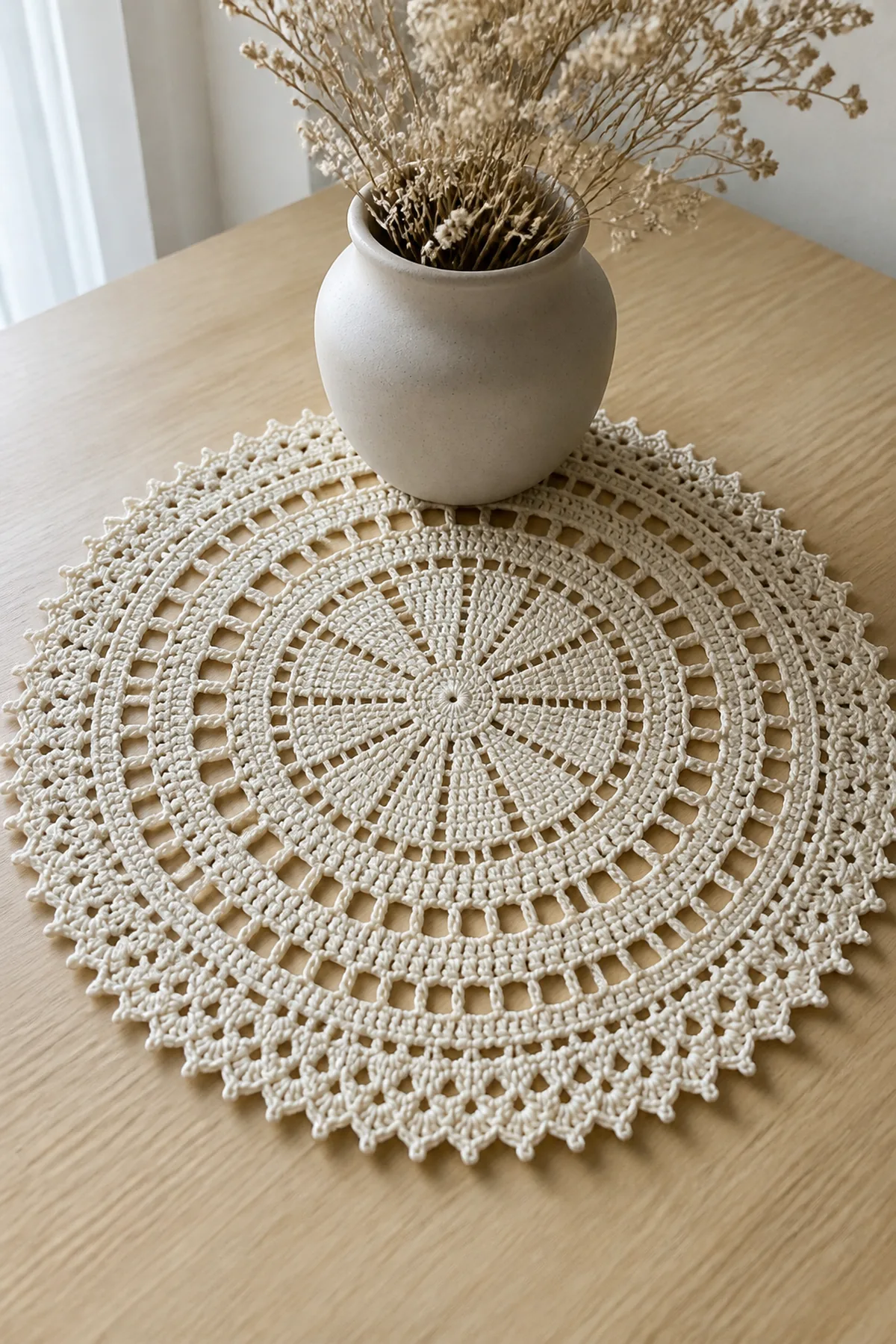
This modern crochet doily free pattern replaces vague lace instructions with twelve marked radial sectors. Each sector consumes its complete share of the previous round and produces one additional counted position.
Pattern Details
- Hook Size: 3.5 mm (E-4)
- Finished Size: Approximately 16 inches in diameter after blocking
- Gauge: First five rounds measure approximately 6 inches across after blocking
- Terminology: US
- Estimated Time: 5–6 hours
- Construction: Twelve marked sectors each gain one counted position per round, expanding a flat radial lace circle from 12 to 120 positions.
- Skill level: Easy
Why You’ll Love It
The ecru circle pairs classic crochet lace with restrained contemporary geometry. Marked spokes and visible position counts make the expanding openwork easier to verify.
Materials
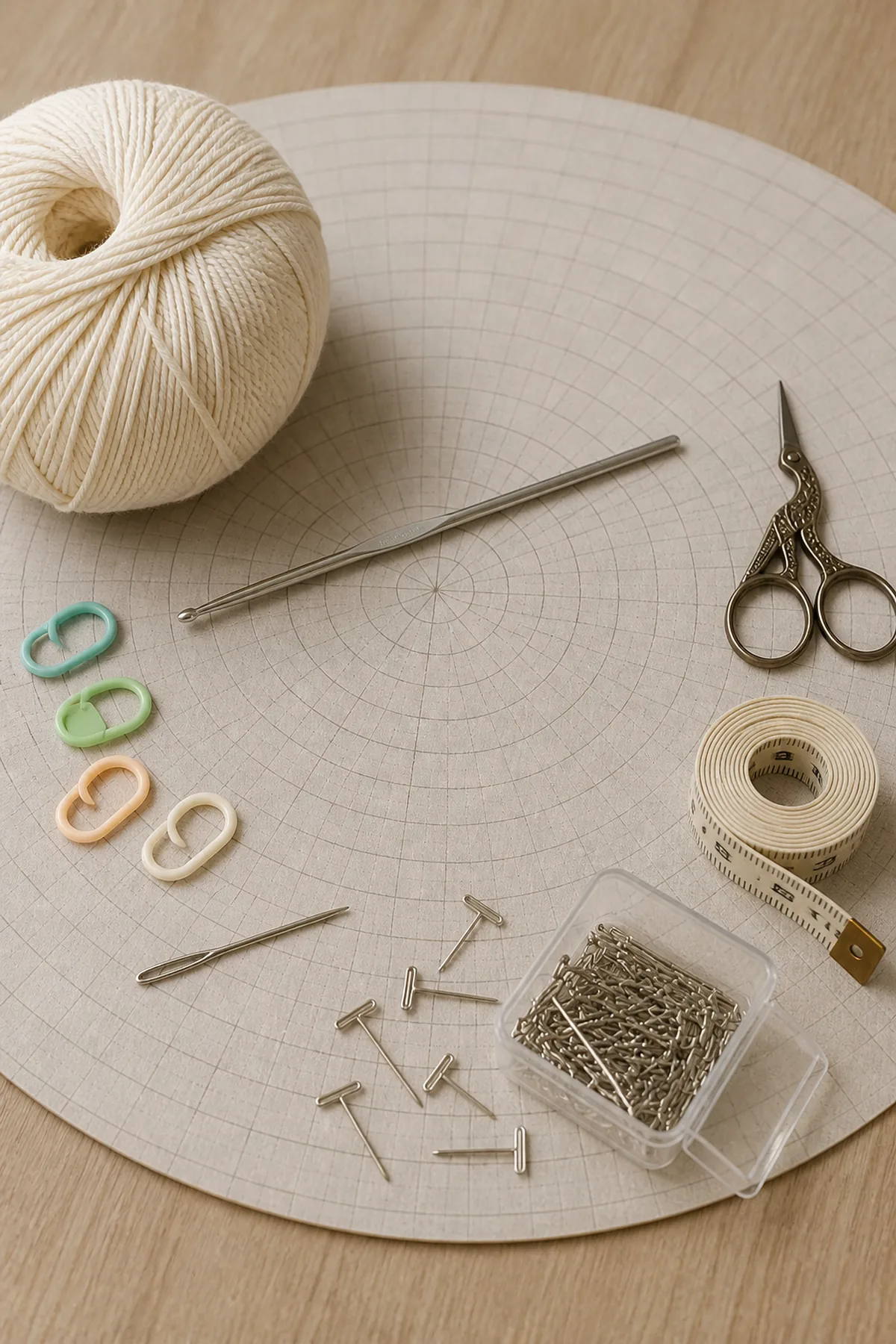
- 420 yards ecru worsted cotton
- 3.5 mm hook
- 12 removable markers
- Yarn needle
- Scissors
- Tape measure
- Rustproof blocking pins and mat
Abbreviations and Special Stitches
- ch: chain
- dc: double crochet
- picot: chain 3 and slip stitch in first chain
- rnd: round
- sc: single crochet
- sl st: slip stitch
- sp: space
- st(s): stitch(es)
A counted position may be a worked stitch or one chain space; each of twelve marked sectors gains exactly one position per round.
Important Notes
- Beginning chains do not count as positions.
- Join each round to the first actual stitch and do not turn.
- Move all twelve sector markers after every round.
- Count chain spaces as stated positions.
- This decorative doily is not rated as a heat barrier.
Complete Instructions
- Rnd 1: Make a magic ring, ch 3 without counting it, work 12 dc in the ring, pull closed, join to first dc, and do not turn (12 sts)
- Rnd 2: In each of 12 radial sectors, work the stated 1-position sector and add one chain-space position at its outer edge. (24 sts)
- Rnd 3: In each of 12 radial sectors, work the stated 2-position sector and add one chain-space position at its outer edge. (36 sts)
- Rnd 4: In each of 12 radial sectors, work the stated 3-position sector and add one chain-space position at its outer edge. (48 sts)
- Rnd 5: In each of 12 radial sectors, work the stated 4-position sector and add one chain-space position at its outer edge. (60 sts)
- Rnd 6: In each of 12 radial sectors, work the stated 5-position sector and add one chain-space position at its outer edge. (72 sts)
- Rnd 7: In each of 12 radial sectors, work the stated 6-position sector and add one chain-space position at its outer edge. (84 sts)
- Rnd 8: In each of 12 radial sectors, work the stated 7-position sector and add one chain-space position at its outer edge. (96 sts)
- Rnd 9: In each of 12 radial sectors, work the stated 8-position sector and add one chain-space position at its outer edge. (108 sts)
- Rnd 10: In each of 12 radial sectors, work the stated 9-position sector and add one chain-space position at its outer edge. (120 sts)
Sector Stitch Map
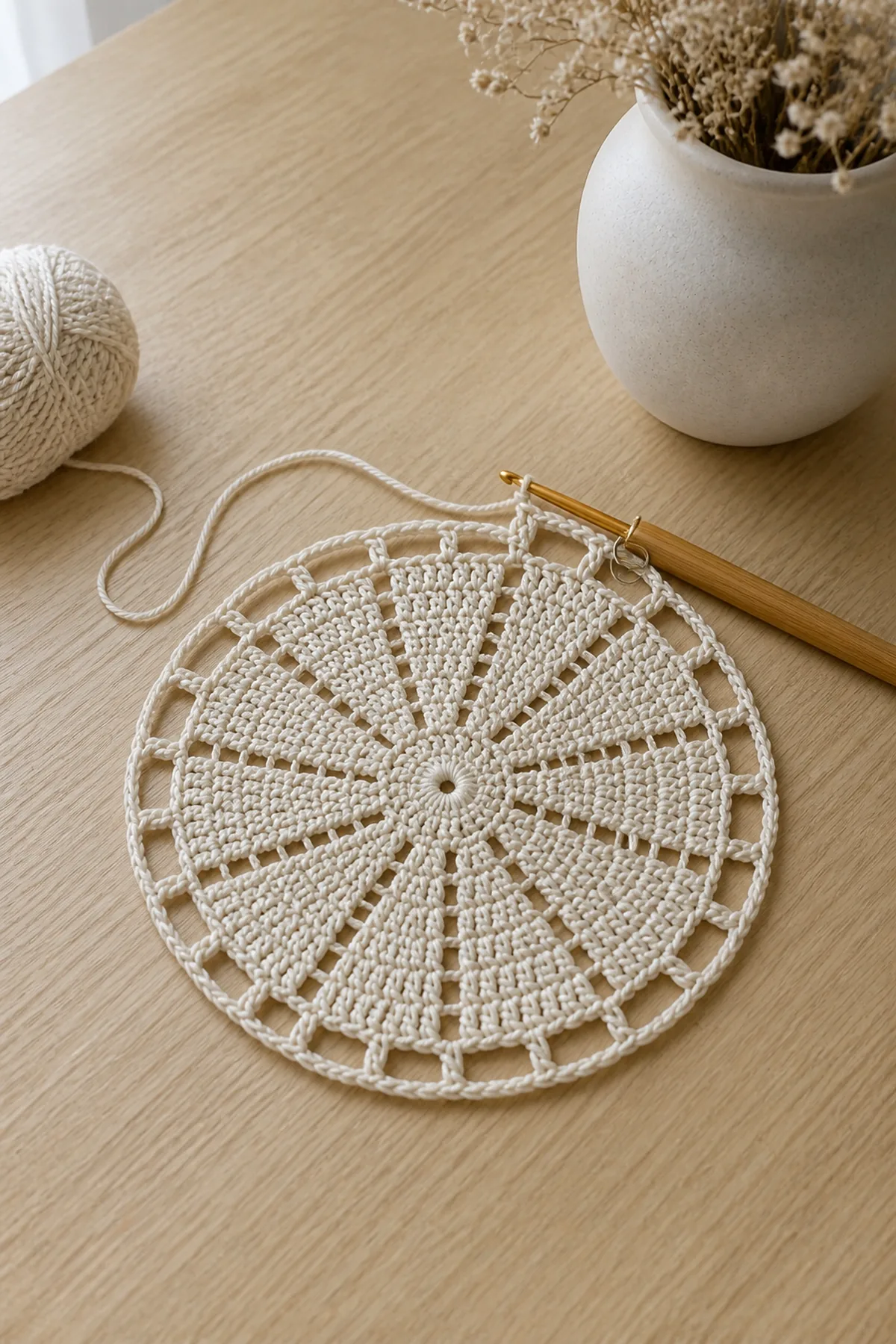
- Rnd 2 establishes one dc and one ch-1 space in each sector.
- Rnds 3–5 alternate dc groups and ch-1 spaces while preserving the audited sector totals shown above.
- Rnds 6–8 form narrow fan arches inside each marked sector; the outer chain space is the one added position.
- Rnds 9–10 repeat the twelve fans and finish each sector with one picot at the outer edge.
At the end of Rnd 10, count twelve identical ten-position sectors for 120 total positions.
Assembly and Finishing
- Join Rnd 10, fasten off, and weave the tail through six ecru stitches.
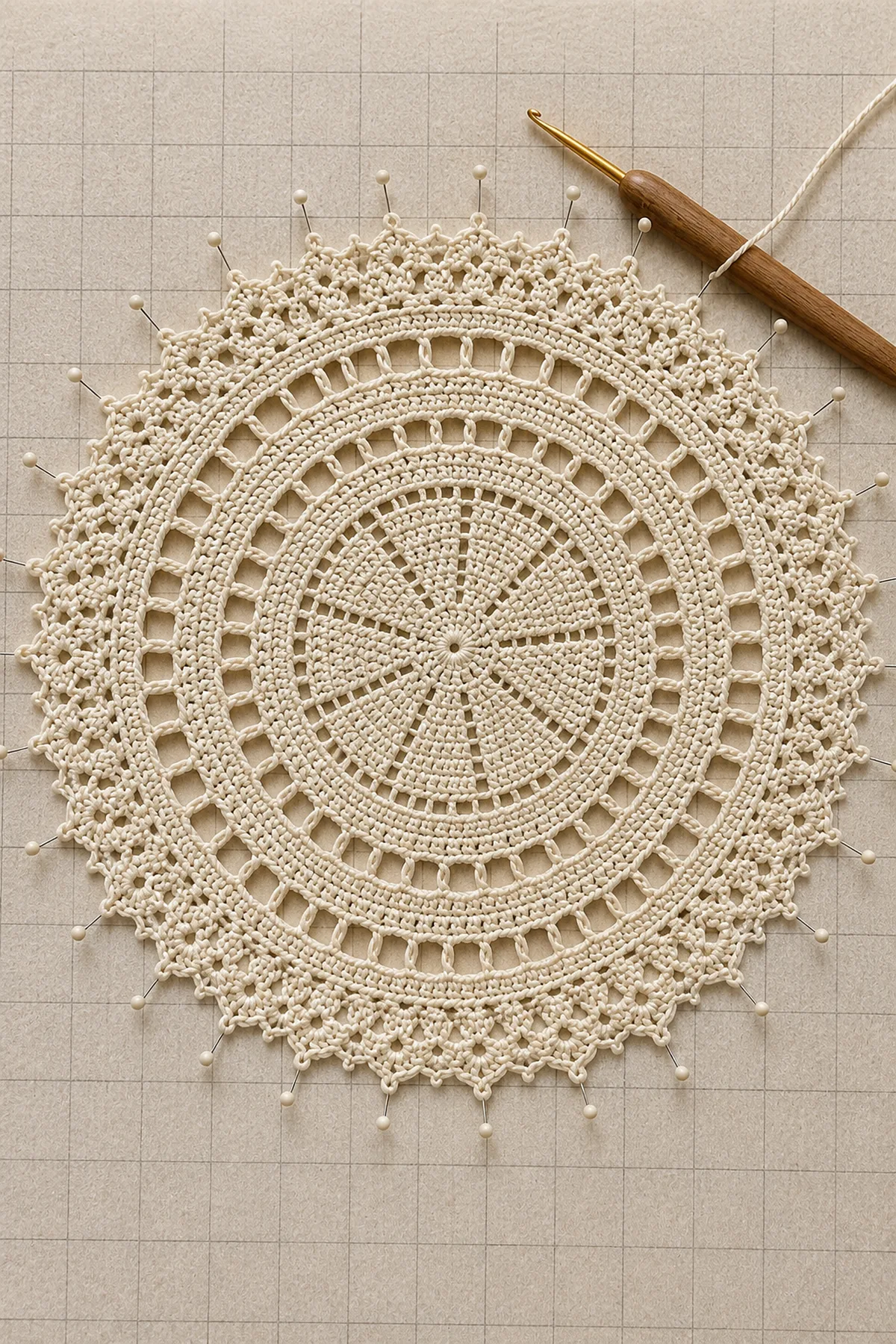
- Soak in cool water, press between towels, and pin all twelve sector points to a 16-inch circle.
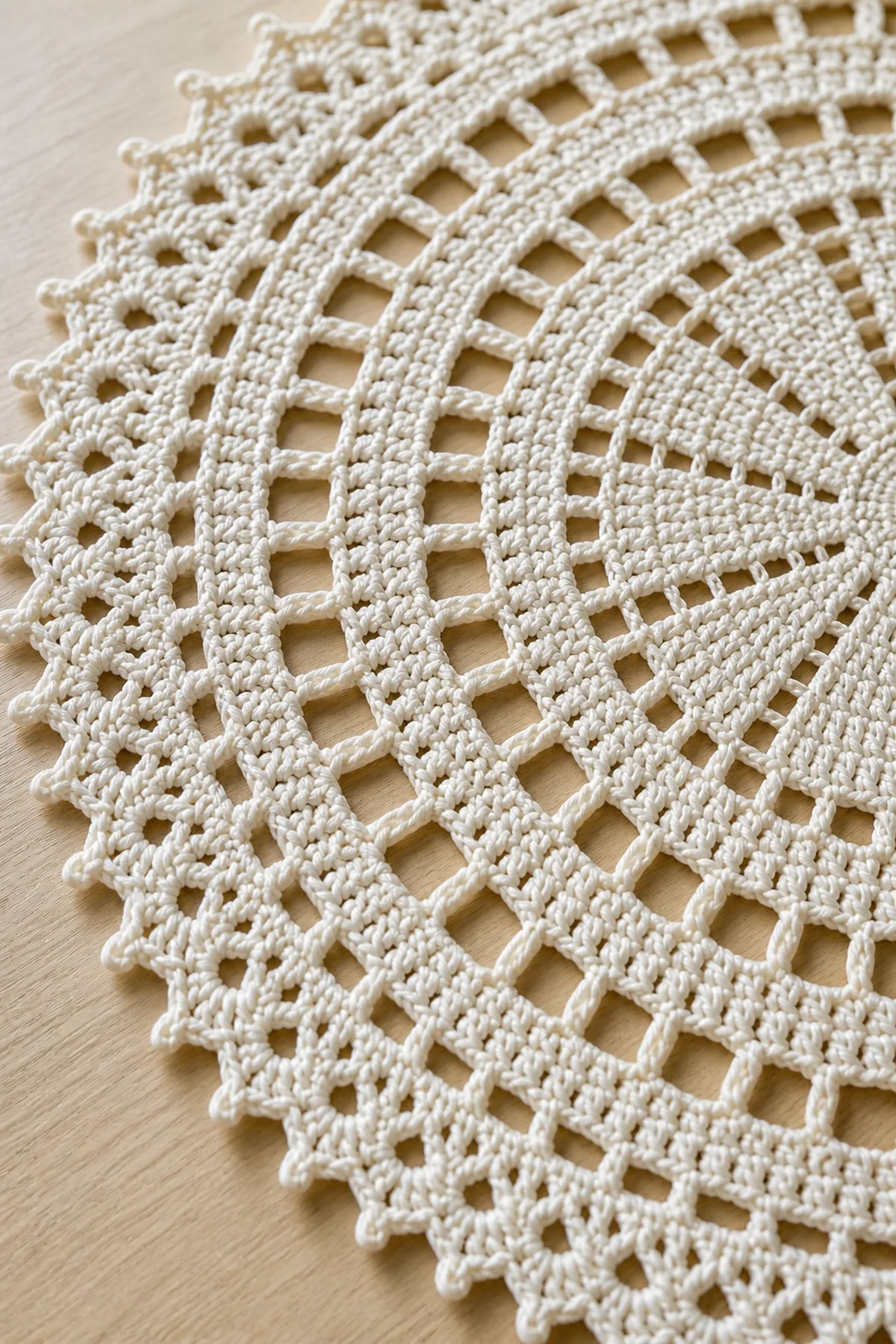
- Let dry completely and confirm the center, open rings, and edge lie flat.
Helpful Tips and Customization
- Use numbered markers from 1 to 12.
- Stop immediately if one sector has a different count.
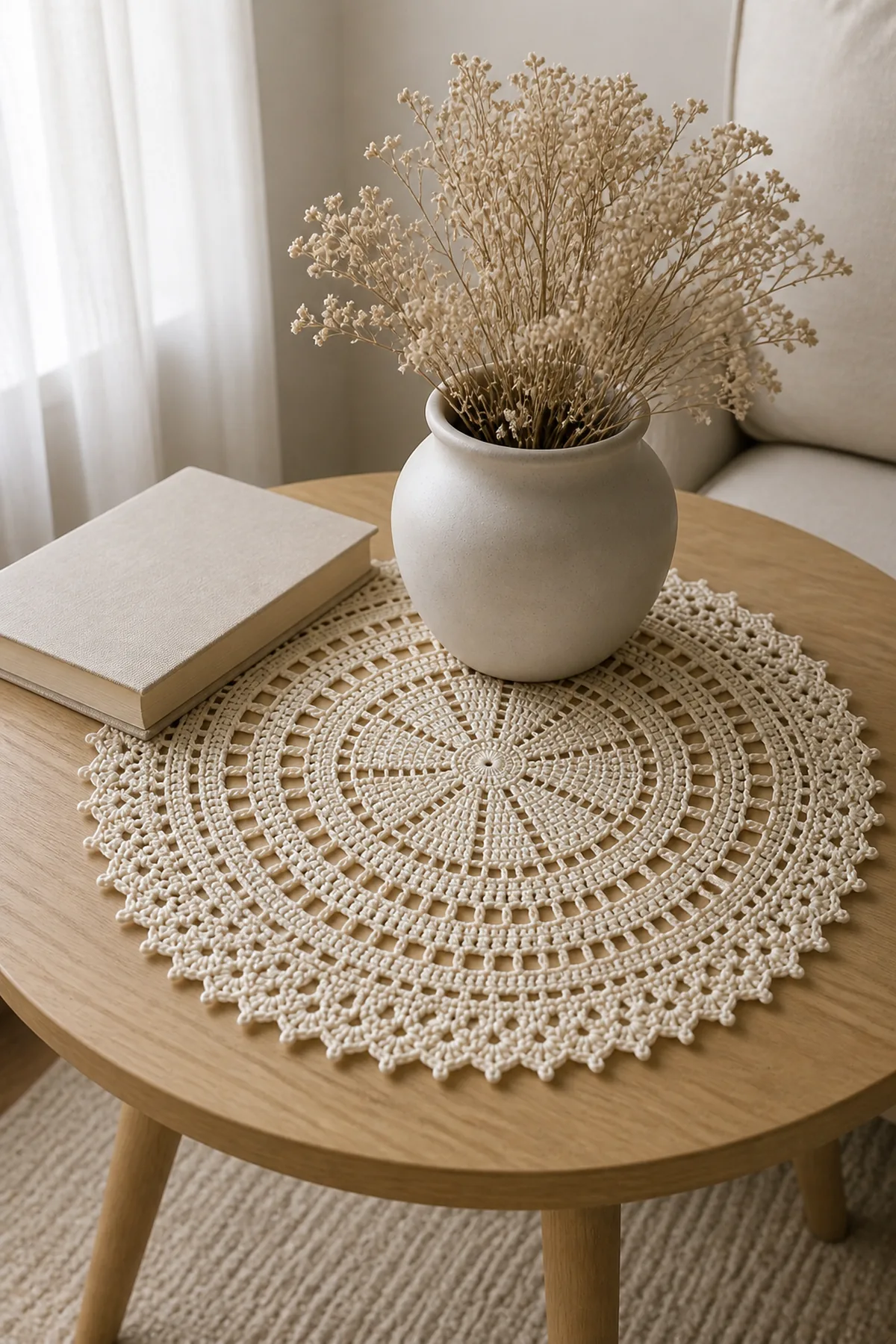
- Choose a contrast table surface so the geometry remains visible.
FAQ
Do chain spaces count?
Yes. Every stated chain space is one counted position in this audit.
Can it protect a table from heat?
No. It is decorative and has no heat-resistance rating.